Ubunya vs Kajabi
Kajabi sells courses. Ubunya runs cohorts.
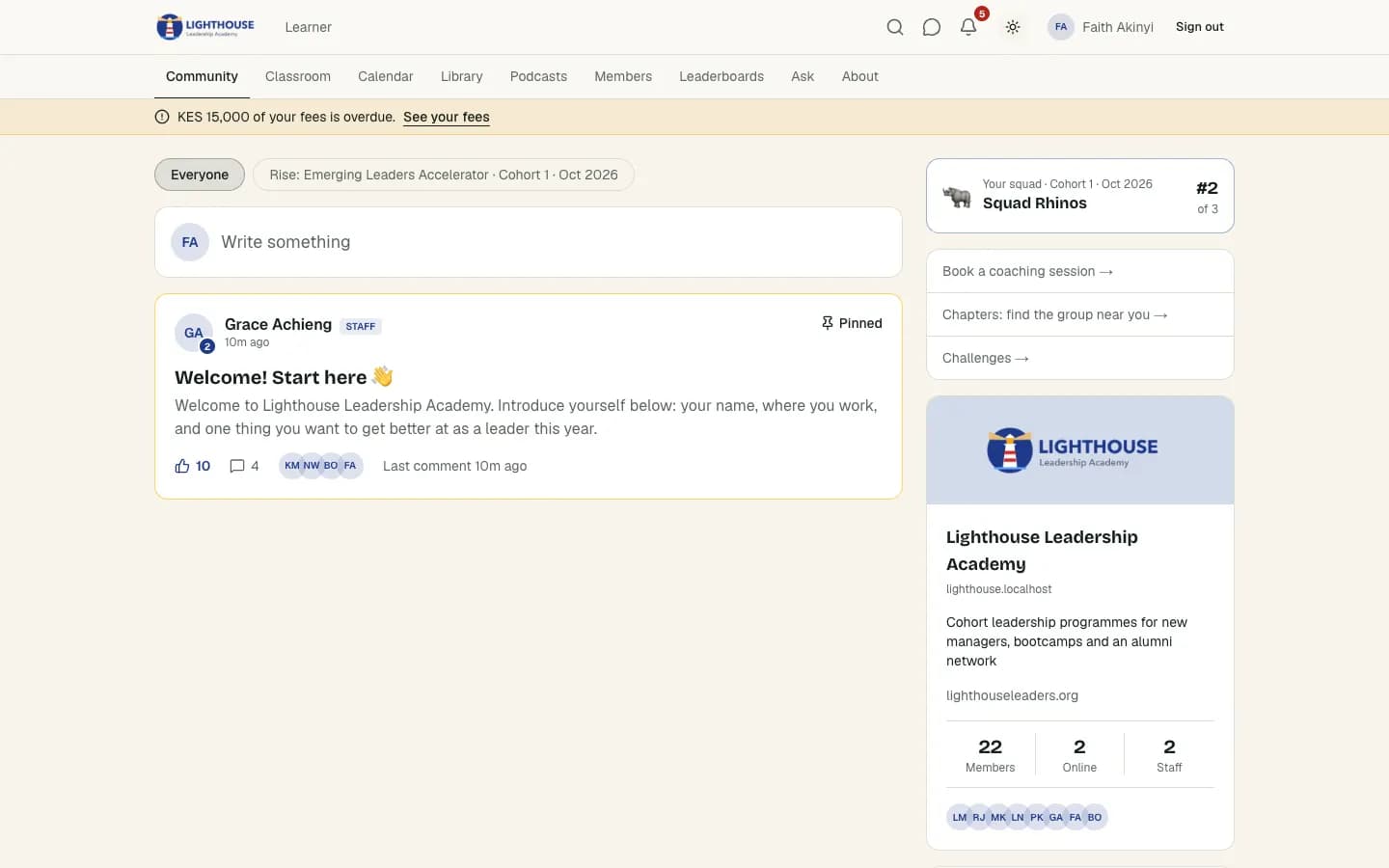
Kajabi is an all-in-one platform for selling online courses: sales pages, funnels, checkout, full email sequences and coaching, with a community as a secondary feature. Ubunya puts the cohort and the community first and handles admissions, attendance and offline fees around them.
The short answer
Choose Kajabi if
- Your business is selling online courses and digital products by card.
- You need sales funnels, order bumps, upsells and full email marketing in one tool.
- Community is a bonus for buyers, not the centre of what you do.
Choose Ubunya if
- You run cohorts with applications, seats, sessions and graduation.
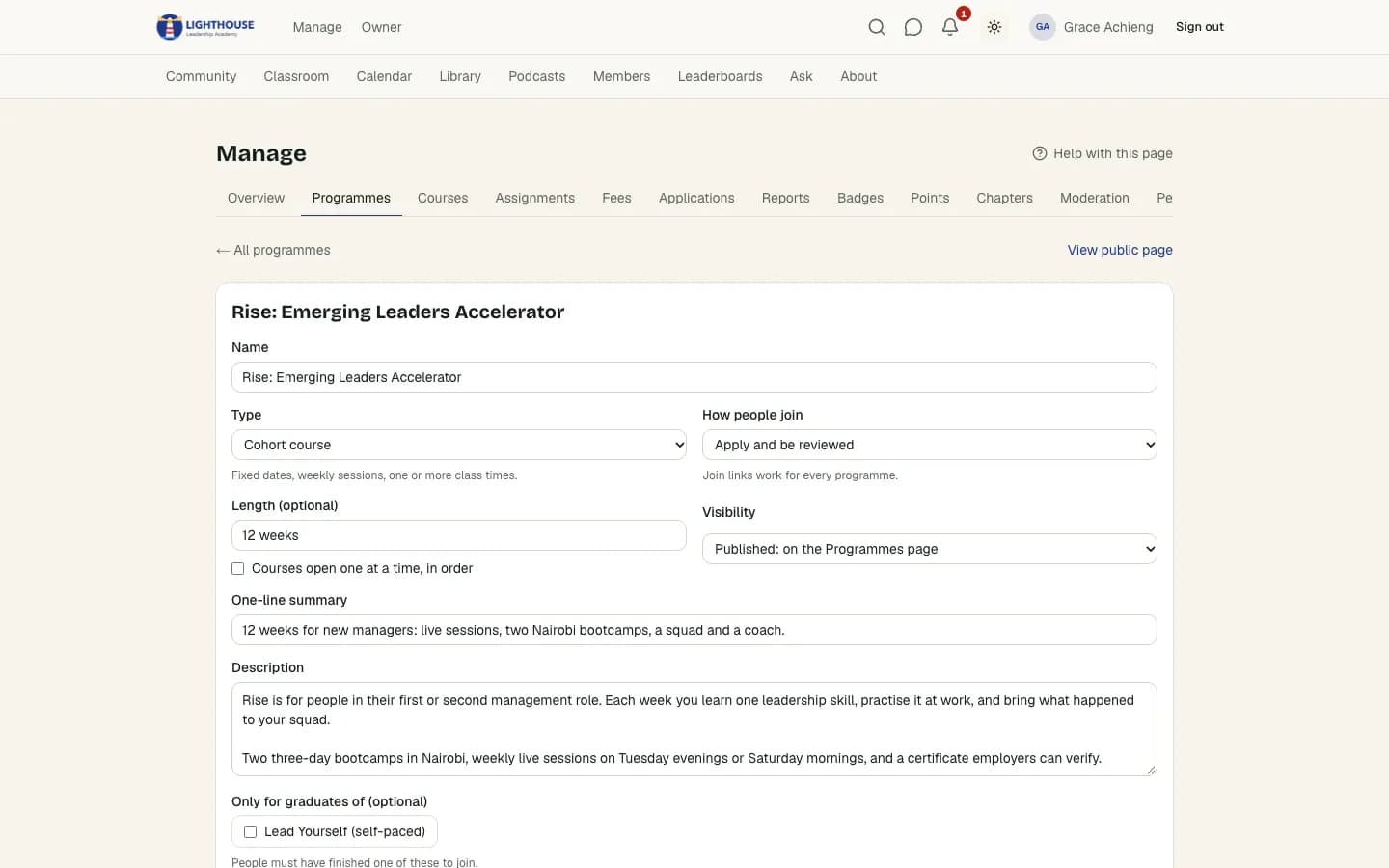
- Learners pay by bank transfer, M-Pesa, UPI, Pix, cash or through an employer.
- Attendance, certificates and impact reports matter to your funders.
- The community is where learning happens, every day.
Kajabi and Ubunya at a glance
- Price
- Kajabi: Basic about $143/month, Growth about $199, Pro about $399 (billed yearly)
- Ubunya: One plan agreed with you, paid by invoice in your currency. Every feature is included.
- Fee on payments
- Kajabi: 0% platform fee, plus Kajabi Payments or Stripe processing
- Ubunya: 0%
- Best for
- Kajabi: Course creators who sell with funnels
- Ubunya: Organisations running cohorts
- Limits
- Kajabi: 1 community and a few products on Basic
- Ubunya: Unlimited programmes and intakes
Feature by feature
| Feature | Ubunya | Kajabi |
|---|---|---|
| Community feed, categories and polls | Community product, secondary to courses | |
| Courses, lessons and progress | Best in class | |
| Points, levels and leaderboards | Challenges | |
| Live sessions | Live rooms in the browser, with breakout groups and recording | Live events and coaching calls |
| Admissions | Application forms with a review queue | Forms on landing pages |
| Cohorts | Intakes with seats, dates and class times | |
| Attendance | Online and in person, with QR check-in | |
| Certificates | Issued on completion, with a public check page | Through add-ons |
| Small groups | Squads inside each cohort | |
| Impact reporting | Impact reports and follow-up surveys | Sales and course analytics |
| Payments made outside a card checkout | Bank transfer, M-Pesa, UPI, Pix, card and cash recorded, with receipts and balances | Card checkout only |
| One payer for many learners | An employer or sponsor pays for several learners | |
| WhatsApp and SMS | WhatsApp and SMS reminders and announcements | |
| Email broadcasts and automatic sequences | Full email marketing and sequences | |
| Phone app | Installable app under your own name and logo | Kajabi app, branded app as an add-on |
| Web address | ubunya.com/yourname, or your own domain | |
| Developer access | Public API, MCP server and CLI | Limited API, Zapier |
| Fee on what learners pay | 0% | 0% platform fee |
Kajabi details as of November 2026, from Kajabi pricing and published reviews. Prices and fees change, so check Kajabi's site before you decide.
What Kajabi really costs
The plan price is only part of the bill. Here is what each platform costs a month when 200 learners each pay $50 ($10,000 a month), on the cheapest plan that can sell memberships, billed yearly where offered: the plan, the platform's fee, and card processing where it is charged separately.
| Platform | Monthly cost | How it adds up |
|---|---|---|
| Skool Pro | $372 | $82 plan (yearly) + 2.9% Skool fee |
| SchoolMaker | $386 | $36 plan (yearly) + 0% + Stripe |
| Kajabi Basic | $493 | $143 plan (yearly) + 0% + Kajabi Payments |
| Mighty Networks Launch | $629 | $79 plan (yearly) + 2% + Stripe |
| Whop | $630 | $0 plan + 3% community fee + 2.7% + $0.30 |
| Circle Professional | $639 | $89 plan (yearly) + 2% + Stripe |
| Skool Hobby | $1,008 | $7.50 plan (yearly) + 10% Skool fee |
| Patreon | $1,350 | 10% platform fee + 2.9% + $0.30 |
| Discord | $1,600 | 10% fee + about 6% desktop processing |
| Ubunya | Your plan | One plan by invoice and 0% on learner payments. Learners pay you directly, by bank transfer, mobile money, card or cash, so nothing passes through Ubunya. |
Worked from each vendor's published prices in November 2026. Fees change and card rates vary by country, so check before you decide.
Cohorts, not just a membership
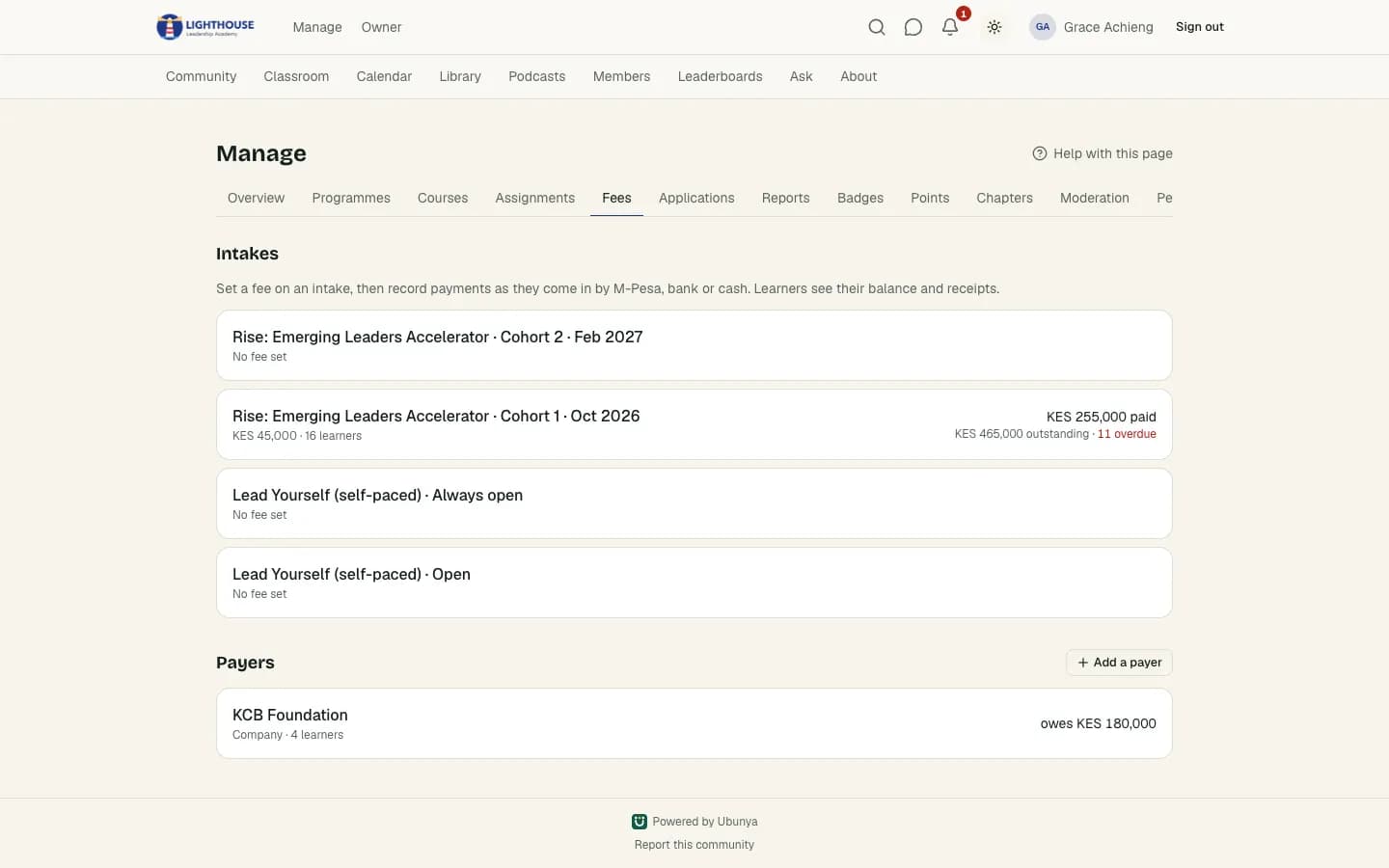
Kajabi is organised around products: a course, a coaching programme, a community. Each is sold on its own, and there is no idea of an intake with seats, sessions and an admissions decision. Ubunya starts from the programme: you open an intake with a start date, seats and class times, people apply, your team admits them, and they move through the cohort together until graduation.
Every learner has a record that follows them: which intake they joined, which sessions they attended, what they paid and which certificate they earned. When a funder or board asks how the last cohort went, the answer is already there.
If you only need an open membership that anyone can join with a card, Kajabi may be all you need. If you admit people into programmes that start and finish, that structure is what Ubunya is for.
Getting paid the way your learners pay
Kajabi charges cards through Kajabi Payments or Stripe. It has no platform fee, but every sale still needs a card checkout. Many of the organisations we work with are paid by bank transfer, mobile money such as M-Pesa, UPI or Pix, a company cheque, a card on their own machine (Visa, Mastercard, American Express) or cash at the first session, often in instalments.
Ubunya records each payment against the learner's fee account, issues a receipt, shows the balance and reminds people before an instalment is due, by email, WhatsApp or SMS. Nothing is taken from what your learners pay: Ubunya charges 0%.
When an employer pays for ten staff, one payer covers all ten seats and gets one invoice, while each learner still has their own place in the cohort.
Marketing tools versus programme tools
Kajabi's strength is selling: landing pages, funnels, checkout pages with order bumps and upsells, and email sequences that nurture leads. If those drive your business, it is hard to beat.
Ubunya's strength is delivering: once someone is admitted, Ubunya handles the timetable, live sessions, attendance, assignments, squads, fees and certificates. It has email sequences and a public community page, but it isn't a funnel builder.
Attendance and certificates that prove the work
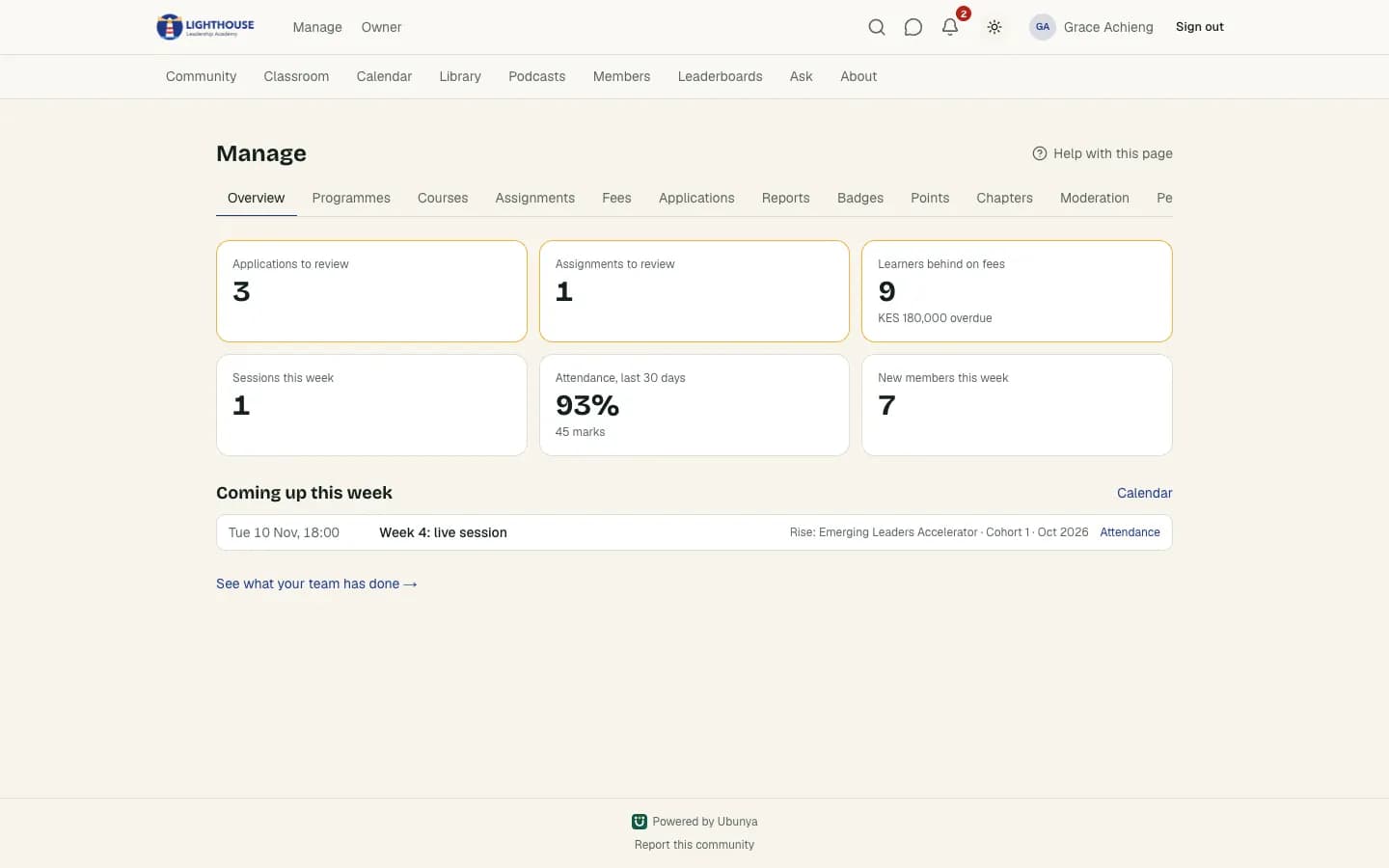
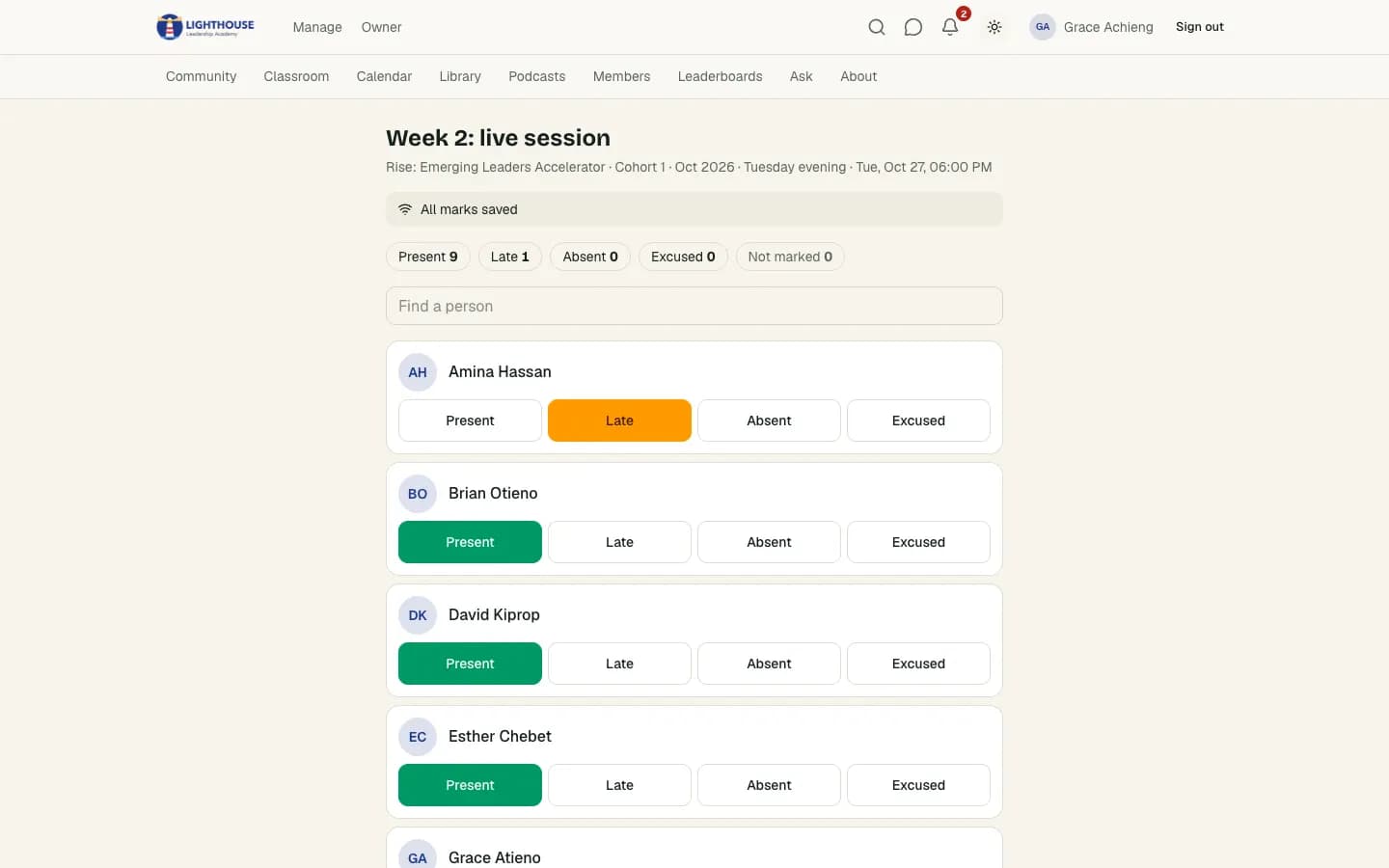
Kajabi tracks lesson progress but has no attendance register for sessions and no native certificates with a public check. In Ubunya, people who join a live session are marked present automatically, and for in-person days staff can tick a register or learners can scan a QR code at the door, even on a weak connection.
Completion rules can require attendance as well as lessons. When a learner finishes, their certificate is issued with a public check page, so an employer can confirm it is genuine.
Where Kajabi is the better choice
No platform suits everyone. Kajabi does these things better than Ubunya:
- Sales and marketing: funnels, checkout pages, upsells and full email automation in one place.
- Polished course delivery for self-paced video courses.
- No platform fee on sales, on every plan.
Moving from Kajabi to Ubunya
- Request a community. We set it up with your name, logo and colours, at ubunya.com/yourname or on your own domain.
- Import your members from a CSV export, with their names, emails and phone numbers.
- Recreate your programmes and courses. Lesson videos can be uploaded or embedded, and we can help with the move when we agree your plan.
- Invite members to sign in. Their history starts in Ubunya from the next intake.
Questions
Is Ubunya a Kajabi alternative?+
For cohort-based programmes, yes. Ubunya covers courses, community, live sessions and email, and adds admissions, intakes, attendance, offline fees and certificates. If you mainly sell self-paced courses with funnels, Kajabi may suit you better.
How much does Kajabi cost compared with Ubunya?+
Kajabi starts at about $143 a month on Basic, billed yearly, with Growth and Pro higher. Ubunya is one plan agreed with you and paid by invoice, with every feature included.
Does Kajabi have a community?+
Yes, Kajabi includes a community product, but it is secondary to courses and funnels. In Ubunya the community is the centre, connected to every cohort, course and session.
Can Kajabi accept M-Pesa, UPI or Pix?+
Kajabi sells through card checkout. Ubunya records M-Pesa, UPI, Pix, bank, card and cash payments with receipts and balances.
Other comparisons
Bring your next cohort to Ubunya
Request a community today. We review every request by hand.